Fun Clubs
Birthday Parties
Climbing Clubs
Kids, children and young people LOVE to climb. It’s natural.
Climbing allows children to challenge themselves against the climb and their own ability. It builds hand eye coordination, balance, physical development, mathematical problem solving, dexterity and patience. And using ropes the sport still relies on team work.
Read more...
Wonderfully we have found that this is a sport almost any child can find a strength in, satisfying the cheeky monkey within.
Climbing indoors in a safe environment not only expresses that climbing urge, it offers great physical exercise and mindful engagement. Flexibility and core strength play a part in the sport too, very similar to gymnastics, yoga and meditation.
Combine this with putting your life in your friends hands as they hold your safety rope, climbing develops trust and life long bonds.
Along with great friendships it also develops responsibility, understanding and often a wanderlust for travel.
Kids, children and young people LOVE to climb. It’s natural.
Climbing allows children to challenge themselves against the climb and their own ability. It builds hand eye coordination, balance, physical development, mathematical problem solving, dexterity and patience. Using ropes the sport still relies on team work.
Wonderfully we have found that this is a sport almost any child can find a strength in, satisfying the cheeky monkey within.
Climbing indoors in a safe environment not only expresses that climbing urge, it offers great physical exercise and mindful engagement. Flexibility and core strength play a part in the sport too, very similar to gymnastics, yoga and meditation.
Combine this with putting your life in your friends hands as they hold your safety rope, climbing develops trust and life long bonds.
Along with great friendships it also develops responsibility, understanding and often a wanderlust for travel.
Wild Climbers
1 hour of fun, game filled, climbing club for young children aged between 3 and 6 years
Youth Climbing Session
1 hour of fun, less games and more climbing club for the older ones aged 12-16 years
Birthday Parties
We know how to make a kids birthday party FUN and EXCITING! It involves lots of games, both on and off the climbing wall.
The climbing & games last 1½ hours.
Birthday Parties run on the weekends all year. Just choose your day and time when you book online.
Ages 5+ 1-6 children £130 (food not included)
NB: Please complete the online form: “My Child is on an Instructed Session” for each child attending the party.
Online booking for up to 6 children only. For more please contact reception for availability.
If you’d like food, please pre-order by email after booking your birthday party. More info on booking page.
Climbing Club Intake (ages 7+)
If it’s your first time on our Climbing Clubs (NICAS) you will need to book onto this Climbing Club Intake.
This course requires no experience and is ideal as a gateway for any young monkey to become a rock climber!
The club will teach the basic safety skills of climbing including: fitting a harness, belaying (safely holding the rope for another climber), climbing, lowering another climber and safely using an indoor climbing wall.
Each session is 1 1⁄2 hrs long and includes the NICAS course book in the price.
Once the basics have been successfully learnt you can move into the Junior or Senior Climbing Club, depending on age.
Your instructor will inform you when it’s time to move into either Junior or Senior Climbing Club.
What is Climbing Club?
Our Climbing Clubs are for children and young people over the age of 7 keen to get more out of their climbing.
These are progressive climbing development courses using the National Indoor Climbing Award Scheme (NICAS) and NICAS Bouldering.
This UK wide scheme is designed to promote climbing development and accredit individual achievement on artificial climbing structures. It can be used as a starting point for people wishing to take up climbing and mountaineering.
The Scheme comprises five levels of award and takes a minimum of 100 hours to complete in its entirety.
Even though we use NICAS and NICAS Bouldering to provide structure and accreditation for the young climbers, our emphasis is on them enjoying the sport and developing their climbing ability:
- to develop climbing movement skills and improve levels of ability.
- to learn climbing rope-work and how to use equipment appropriately.
- to work as a team, communicate with, and trust a climbing partner.
- to provide a structure for development, motivation and improved performance.
- to develop an understanding of the sport, its history and future challenges.
- to provide a record of personal achievement.
- to point the way to further disciplines and challenges in climbing beyond the scheme.
The clubs run on weekends and after school all year round, with a break over Christmas and the school summer holidays.
NB: if it’s your child’s first time on Climbing Club, you MUST book onto the Climbing Club Intake course first. There is no intake required for Boulder Club.
All courses are £69* monthly direct debit.
*intake course is a one off payment, price depends on duration of course. Please check when booking.
Junior Climbing Club (ages 7-11)
Once you’ve completed the Climbing Club Intake course it’s time to move into Junior Club if you’re ages 7-11 years.
Junior Club will continue to develop these skills and good practices along with climbing techniques and movement skills. This is aimed at ensuring a candidate possesses the knowledge and skill to climb and belay safely at any climbing facility (whether or not under supervision or with back-up) and operate in a responsible manner.
Achievement at this level is broadly equivalent to a pass at GCSE.
Each session is 1½ hrs long.
Please contact reception to book after completing the Intake.
Senior Climbing Club (ages 11-17)
Once you’ve completed the Climbing Club Intake course it’s time to move into Senior Club if you’re ages 11-17 years.
Senior Club will continue to develop these skills and good practices along with climbing techniques and movement skills. This is aimed at ensuring a candidate possesses the knowledge and skill to climb and belay safely at any climbing facility (whether or not under supervision or with back-up) and operate in a responsible manner. Achievement at this level is broadly equivalent to a pass at GCSE.
Each session is 1½ hrs long.
Please contact reception to book after completing the Intake.
Leaders Climbing Club (ages 11-17)
The first rule of Leaders Club is there IS no Leaders Club!
That said, scrolls carried by snow white owls do occasionally go out under the cover of darkness, inviting the chosen few into its hallowed folds!
This club is for young people learning and practising Lead Climbing. Because of the inherent risk involved with lead climbing, joining the Leaders Club is by invite only after the climber demonstrates they have the knowledge and skill to climb and belay safely unsupervised in a responsible manner.
The young climber will initially be invited to try one of our free Lead Climbing Taster Sessions to see if they enjoy it and feel they would like to join the Leaders Club.
Lead climbing isn’t everyone’s cup of tea, but for those with a good head for heights, happy to take longer falls and push their limits, lead climbing opens up a whole new level of climbing!
Includes using the lead walls, top ropes, boulders and Psicobloc.
Each session is 1½ hrs long.
Please call or pop to reception to book if you are already on NICAS Level 4 or 5 or have been invited to join the Leader Climbing Club.
Boldering Club
Very similar to our climbing clubs above but without the ropes! And because ropes aren’t involved, there’s no need to do the Intake Climbing Club first.
The aims of NICAS Bouldering are laid out below:
- to develop climbing movement skills and improve levels of ability
- to learn how to use equipment appropriately
- to develop risk assessment and risk management skills in the sport
- to work as a team, communicate with, and trust other boulderers
- to provide a structure for development, motivation and improved performance
- to develop an understanding of the sport, its history and ethics
- to provide a record of personal achievement
- to point the way to further disciplines and challenges in climbing beyond the scheme.
Each session is 1½ hrs long and includes the NICAS Bouldering course book for the first session.
Can we just turn up and let the kids have a go?
All children aged 16 and under need to be supervised by an adult when at The Boardroom.
NB: We now run a strict supervision ratio of two children to one adult.
If you are an experienced climber then they can be supervised by yourself. If not then they will need to be supervised by one of our instructors.
It’s just not safe to let your children play on the wall without correct supervision as climbing can be a dangerous sport.
There are a few options available to you to get your kids climbing:
- Book yourself onto a “Family Taster” session if you’d like to join in!
This is an hour long under the supervision and guidance of one of our fantastic instructors. The Family Taster is a great way to try the sport out and see if they enjoy it. - On weekend mornings (and week days during school holidays) we run our “Fun Clubs“: “Wild Climbers“ for ages 3-6, Caterpillars” for 5-7 yr olds, “Funky Gibbons” ages 7-11 and “Youth Climbing Club” for the 12-16 year olds.
- If you’re sure your child will love climbing, or if they’ve tried climbing, enjoy it and want to progress in the sport, then why not enrol them onto one of our “Climbing Clubs”These development courses run all year round, every day of the week, and are a great way to learn climbing or bouldering.
At our Climbing Club we deliver the National Indoor Climbing Award Scheme (NICAS), for which we are one of the countries primary centres. These awards also counts towards GCSE and DofE!
Head to our Climbing Clubs page for more info and to book onto the Climbing Club Intake course to get started.
- As a parent if you do either our “Bouldering Safety Course” or our “Rope Safety Course” then you will be able to bring your child climbing by yourself.With the safety knowledge and skills learnt you will not require one of our instructors to instruct your child. It also gets you involved in your child’s sport, and you never know you might enjoy climbing yourself!
- We also do fun kids birthday parties!
My kids are booked on a session, can I just drop them off?
Unfortunately not. Even when children are booked onto a session run by our instructors, a parent/guardian must remain in the building. Or in our lovely garden, soaking up the sunshine, devouring a pizza and washing it down with a cold beh, buh, beverage!
If your child is in “Climbing Club” please refer to the Climbing Club Handbook.
What is Indoor Climbing?
Indoor climbing (sport climbing) is a form of rock climbing carried out indoors on artificial structures which attempt to mimic the experience of climbing outside.
Originally used by climbers as a way to train for climbing during the wet winter months, indoor climbing has now become a sport in its own right with many new climbers using it as a sociable and enjoyable alternative to working out in the gym!
Sport climbing, along with Bouldering and Speed Climbing, have been in the last two Olympic Games. With a GB Athlete taking gold in Paris!
What is Bouldering?
Bouldering in essence is the simplest and purest form of climbing. Just you, your climbing shoes and some chalk (oh, and some comfortable clothes/gym kit!). No need for a harness or rope!
Not only is it a great way to get fit and tone up, it also increases flexibility and mindfulness, a bit like yoga, challenges your problem-solving kills and has the added bonus of being a very sociable sport.
Thankfully you’re never that far from the ground (well, up to 4.5m) which is covered with thick foam matting*. Without the harness and rope it also means it’s a much cheaper way to start climbing.
*the matting does not eliminate the risk of injury.
What is Top Roping?
Top roping is without doubt the safest and easiest to learn of the two methods used in indoor climbing where a rope is required for safety (the other being “lead climbing”).
While top roping indoors (here at The Boardroom the top rope walls are the green wall and Tower) the rope which is always in place, runs smoothly through an anchor* at the top of the wall, with both ends of the rope reaching down to the floor. The climber ties into one end and the belayer attaches to the other.
As the climber ascends the wall the belayer takes in the rope ensuring there is no slack rope between themselves, the anchor and the climber. Should the climber fall off, the belayer prevents the climber from dropping by locking the rope in the belay device.
Because the rope passes through the anchor at the top of the wall, the climber is supported by the rope from above, despite the belayer being on the ground. This is why it is called “top roping”; the rope is always at the top, above the climber. This ensures that any fall a climber takes results in them falling no distance at all.
* In indoor climbing the anchor at the top of the wall consists of two karabiners attached to the wall structure via steel chains and bolts. The rope runs through the karabiners.
Indoor climbing wall anchors are weight tested on site to ensure they can hold 800kg!
How much weight can a climbing rope hold?
Climbing ropes tend to have a breaking strain of 2,400kg which is more than a car or even an SUV! You’re going to have to eat a lot of tiffin to break one!
Most items of climbing equipment such as karabiners, harnesses and slings have a similar breaking strain.
What are the Auto-belays?
An auto belay is an automatic belay device that eliminates the need for a human belayer.
The auto belay is attached to the top of the wall taking up the slack as a climber ascends and controls the descent when the climber reaches the top or in the event of a fall.
And what is the, how do you say it, Psicobloc?
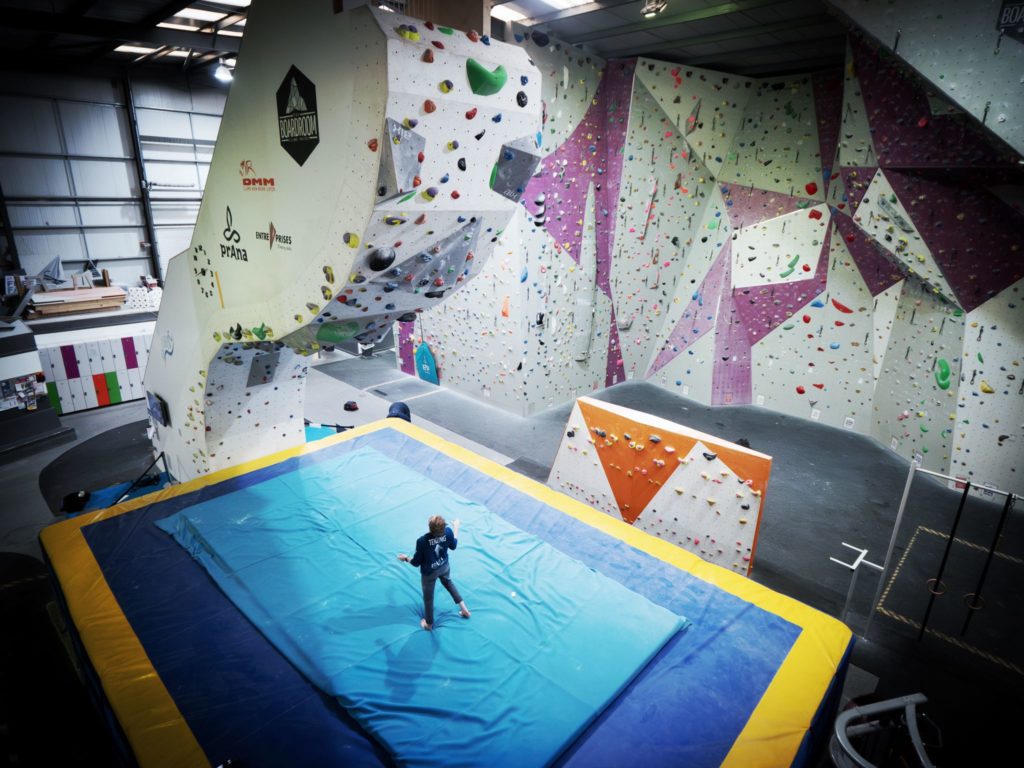
The Psicobloc (pronounced; see-koh-block) at The Boardroom is just a very high boulder, 8 meters high to be precise and very steep/overhanging with extra deep matting below it to take your fall!
The word Psicobloc is Spanish and its direct translation is “crazy boulder”. It’s also another name for DWS (Deep Water Soloing) which involves climbing rock faces above water, usually sea cliffs, free solo without a harnesses or ropes and using the water to break your fall!
We thought it was a pretty apt name for our solo wall as it is a pretty crazy boulder. So far it’s the only indoor one in the UK, and only a handful in the world!